


Safe in India Foundation – Annual Review 2025.

From Injured Workers to National Change
Every year, thousands of workers in India’s manufacturing supply chains leave for work expecting an ordinary day.
Some return with permanent injuries.
Some never return at all.

Behind India’s growing manufacturing ambition lies a quieter reality - one that unfolds far from boardrooms and policy documents, inside auto component factories where safety and social security (ESIC) systems often fail when they are needed most.
At Safe in India Foundation, we work at this intersection - where human lives, industrial systems and economic ambition meet.
Why 2025 Was a Year of Convergence
Since 2019, we have been engaging with 100+ stakeholders in the automotive industry, the government and its relevant agencies, with the argument that working conditions are both a social and an economic issue. Not everyone bought into that argument and a few even objected - often conveniently, driven by short-termism, a malaise in Indian business practices.
In 2025, that changed for the better.
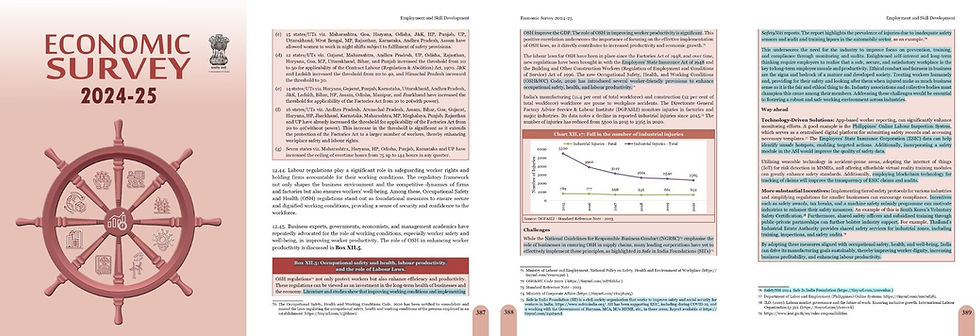
India’s Economic Survey 2024-25 reflected a crucial shift by accepting our argument - recognising that working conditions, worker safety and good social security are central to labour productivity, manufacturing competitiveness and long-term economic growth. Thanks!
This matters deeply.
Because a manufacturing economy cannot become globally competitive if injuries remain invisible and ununderstood - and if productivity is built on human cost rather than professionalism.
Standing With Injured Workers When It Matters
At the foundation of Safe in India’s work are injured workers and their families - often navigating complex ESIC systems at a moment of shock and uncertainty.
In 2025, with the support of our donors and partners:
4,836 workers received direct assistance - highest ever.
₹53.36 crore in ESIC healthcare and compensation was secured - highest ever

See our Full Impact Report here.
For families, this support meant access to treatment, income continuity and stability at a moment when everything felt fragile.
For many, it meant not slipping permanently into poverty after a workplace injury.

Turning Experience Into Evidence: CRUSHED2025
Individual cases tell stories.
Aggregated responsibly, they reveal systems.
Over time, Safe in India’s work with injured workers has produced a clear pattern: Nearly 80% of serious injuries originate in the automotive supply chain, especially among Tier-1, Tier-2 and Tier-3 suppliers.
We released CRUSHED2025 (see full report blog here), our seventh annual report on worker injuries on the automotive sector.

The findings remain concerning. A few:
90% were employed within the supply chains of the top 10 automotive brands.
76% of injured workers reported working over 60 hours per week - Illegal.
97% had no formal appointment letter - Illegal.

The message is not one of blame - but of opportunity.
Prevention is possible.
Systems can be strengthened.
Professionalism can be improved.
From Injury Data to Automotive Brands’ Boards' Governance of their Supply Chain: SafetyNiti 2025
While injury data highlights outcomes, prevention requires governance.
Through SafetyNiti2025 (see full report blog here), 4th annual report in this series, Safe in India continues to assess the worker-safety governance frameworks of India’s leading automotive brands.
Over five years, important progress has been visible:
Supplier Codes of Conduct in the public domain increased from 2 to 9 brands
OSH policies from 5 to 9 brands
Human rights policies from 0 to 7 brands
Expectations extending into Tier-2 supply chains expanded significantly

These are meaningful steps forward. Thanks!
The challenge ahead lies in consistent and better implementation in the supply chain, at least Tier 1, 2 and 3 where majority of these accidents occur - from now the central focus of this engagement.
Early Signals of Improvement - Long Way to Go
In Haryana, where engagement has been the earliest :
Worker injuries declined during 2022 and 2023 (like for like Manesar+Faridabad)
Rose AGAIN in 2024 - alongside production growth and a new Worker Centre in Gurugram
Early analysis for 2025 shows a reduction of 2.8%, despite sector expansion.
These are correlations at best. Causality is difficult to establish due to limited state data from the industry and the government.
Strengthening the Institutional Framework
In 2025, Safe in India’s engagement expanded further into institutional reform:
A joint national study with IICA and the Ministry of Corporate Affairs analysing BRSR disclosures of 50 listed auto companies is nearing completion
This work is contributing to new National Guidelines for Responsible Business Conduct for the automobile sector, expected later this year
Our recommendation on power-press safety standards, which was approved by the Bureau of Indian Standards awaits enforcement.

Power-press machines account for nearly two-thirds of serious industrial injuries — making prevention both urgent and achievable.
Empowering Workers Through Knowledge
Safety improves not only through policy - but through awareness.
In 2025, we started a new training initiative:
48 worker training sessions were conducted in Pune factories and Gurgaon communities.
4,800+ workers were trained on ESIC, health rights and documentation.
Digital ESIC and safety content viewed by over one million workers nationwide - a record for us.


Many of these workers applied for ESIC cards for the first time.
Many added their family members as they should have all along.
Many began asking informed questions.
A few employers started recruiting women workers and providing ESIC cards.
Knowledge builds safer systems. Ignorance makes them worse.
Looking Ahead: The Next Three Years
Reform is not quick.
It requires persistence, trust and time
Yet momentum is now visible. There is some improvement in brand governance and in ESIC processes, an opportunity for better alignment across stakeholders and a growing ecosystem committed to improvement.
Over the next three years, Safe in India aims to:
expand worker support centres from 5 to 10 across other auto component manufacturing states/hubs
Doubling workers assisted from 15,000 to 30,000
Doubling ESIC/LWF compensation assisted from Rs 150 crore to Rs 300 crores
Further deepen collaboration with industry and government
Publish India’s first annual ESIC service-quality report
Release a national OSH report on manufacturing with civil-society partners

The goal remains simple and shared: safer and more secure workers, stronger businesses, and a more competitive India.
Thank You
Every worker assisted represents a family protected from lifelong vulnerability.
Every improvement in safety and quality of ESIC services strengthens India’s manufacturing future.
Thank you for standing with Safe in India Foundation - and for believing that economic growth and human dignity must move forward together.
We would love to hear your thoughts.


Very satisfying progress and clear specific future targets. It is much needed work. Best wishes