


What’s different in the lives of women workers in the auto sector factories?
Introduction
Since 2018, close to 3,000 women workers, of which more than half from the auto sector, have come to Safe in India Foundation for help in claiming the social security they are legally entitled to. More than 1,500 were already disabled by high risk machines in their factories. Every year, more women workers, injured and non-injured, come to us than the year before.

Binita, aged 44, worked in an auto factory, supplying to Maruti, near Sona village, alongside her husband, until her hand was crushed on a power press. A year later, her hand still hurts and she is no longer able to carry out her life the way she used to. She cannot cook, clean or run the household like before. Her husband goes to work, comes back tired, and still cooks their meals and washes their clothes. "I am lucky to have him as my life partner," she says.
Many women are not as lucky as Binita.
Sucheta, aged 44, working in an auto factory that supplies to Hero, Honda and Maruti, suffered a similar injury in 2022. Her wages were cut soon after, and she remains in fear that her husband would beat her if she did not bring money home.
At the release of our accident prevention report CRUSHED 2023, which included a focus on women workers, Prof. Nisha Srivastava of the Institute for Human Development remarked that
Prof. Nisha Srivastava, Institute for Human Development
How we started focusing on injured and non-injured women workers since 2023
SII's early fieldwork did not focus on gender. However, during a field visit in worker villages in Faridabad, we found that there were many women in the same village, who work in nearby auto sector factories that employed a large number of women because they were ‘cheaper and harder working’.

It was around this time, in 2023, that we also widened our work beyond injured workers, to also support workers who had not yet been injured, and to focus on the gender-specific issues such as maternity benefits, shaping how women workers accessed benefits.
A double burden on and for, often underpaid, women workers
Women workers struggle with every hurdle that men workers face in claiming their benefits, along with an additional set of their own. Maternity is one example.
During maternity leave, some employers mark women workers as "Left" on the ESIC portal. This leads to erasing the very benefit women workers were legally entitled to during their maternity leave. Beyond this, salary slips and appointment letters are often not provided. ESIC contributions are not deposited on time. Benefits are often delayed by a year or more.
Women are also paid less than men for the same work. Prem Lata, aged 36, lost 2 of her fingers while operating a power press at an auto factory in Faridabad supplying for Hero, Maruti and Honda. She told us that she was earning Rs. 11,700 on a Maruti supply line when the men beside her earned Rs. 13,000. Pooja, aged 30, similarly lost 4 of her fingers at an auto factory. She told us that women always earn less than men and she earns as little as Rs. 9500 for work that is so dangerous.
Watch women workers discuss these issues in detail:

Once injured, livelihood options available to women narrow further. Neetu Devi, our shramik saathi, aged 35, has been injured thrice on a power press and still runs the same machine in the same factory, because no one else will hire her. Like many women workers, she escaped abusive or difficult living conditions at their marital homes in villages they got married into, with the hopes to earn a decent living for their children.
Watch Neetu Devi and her family talk about the impact of these injuries on her family:
The consequences reach further for a woman worker than for a man. A woman worker earns for the household as well as runs it. When she is disabled, the livelihood and functioning of the household come apart. Cooking, caregiving, and simple tasks around the house become difficult with a permanent hand injury. The income of her household drops significantly, if not entirely, at once.
Women workers become dependent on the family they once supported. Women workers commonly describe a loss of confidence and of feeling that they have become a burden on their loved ones. When Neetu Devi was injured, her son left school in Class 8 and started working to support the family. He lost his opportunity to pursue proper education.

Neetu Devi is not alone. Many women continue on these machines because they have no alternative. Some are the sole earners after a husband's death, or after being abandoned. Others are covering rising household costs, or paying for their children's schooling. For most, taking on dangerous work is an economic necessity.
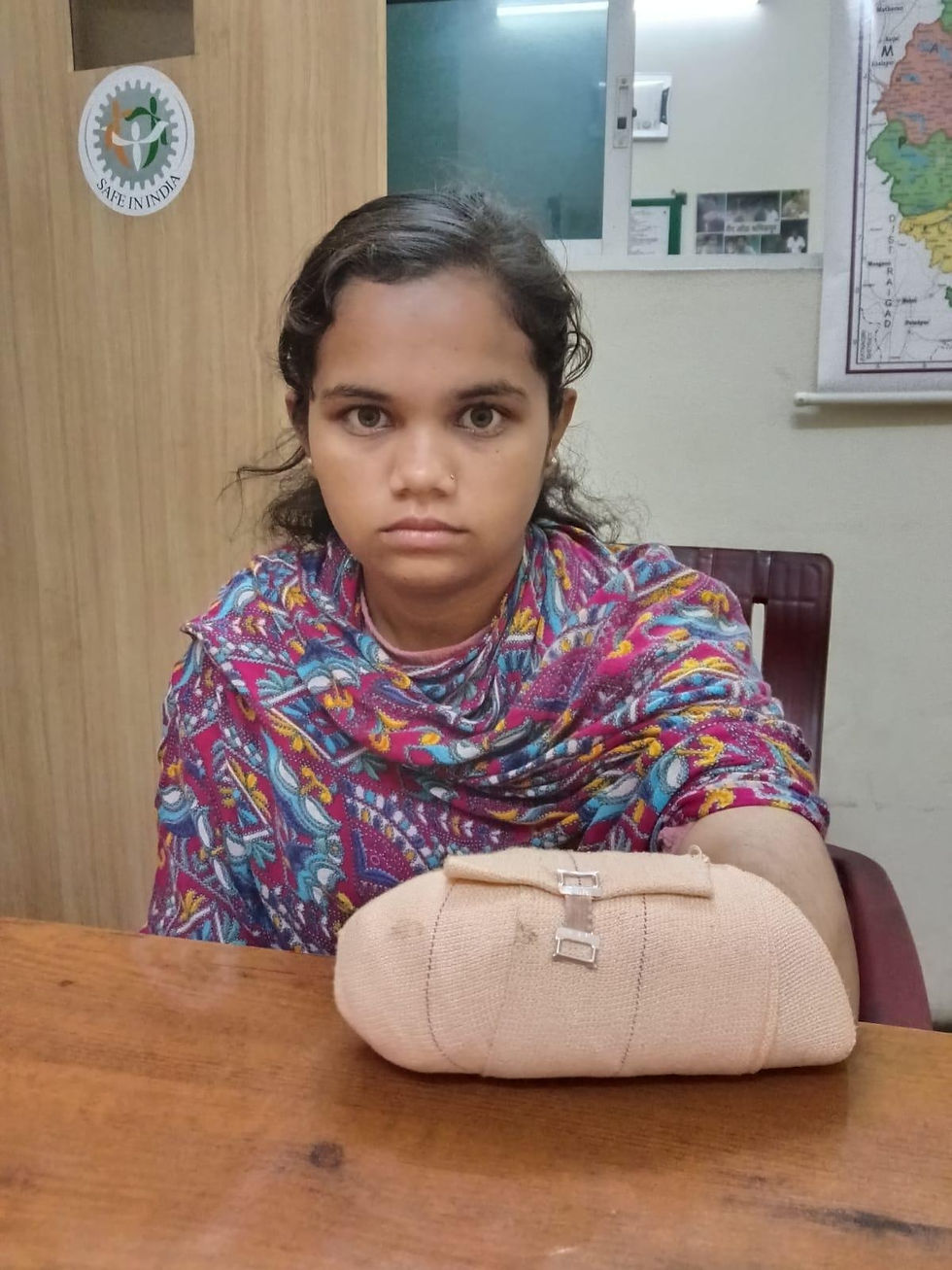
She is 16. It was her first day.
Dhaneswari Rathod is 16. She had just written her 10th grade exams. Economic circumstances at home meant she had to come to work with her mother to support the household.
On her first day at Gloriya Engineering Industries, a Pune-based auto parts factory that supplies to Tata Motors, she was put on a power press machine with a known faulty screw. A supervisor tightened it and told her to run the machine anyway. Mid-shift, the screw came loose. Her left hand was cut. Weeks later, her employer has still not issued the accident report she needs to claim ESIC benefits. SII is helping her family.
A recent case from SII's fieldwork
What SII does for these women workers, and where?
Since 2016, SII has expanded its श्रमिक सहायता एवं सुविधा केंद्र (Worker Support Centres) across six industrial clusters, Manesar, Gurugram, Faridabad, Chinchwad, Chakan and Chennai. At each Kendra, SII counsellors locate struggling men and women workers who are eligible for benefits, prepare and submit their claims, and follow each case through to receipt.
When employers refuse to hand over salary slips or appointment letters, our counsellors press for them. When cases are delayed, they are escalated through ESIC’s Suvidha Samagam and CPGRAMS after making all the efforts possible in the ESIC branches and offices. Our counsellors accompany women to government offices in person where needed.

Benefits received by women workers, awareness building and ESIC process improvement advocacy

The outcomes speak to what this handholding process delivers. For around 250 women whose factory injuries left them permanently disabled, SII has secured a lifetime ESIC pension that is worth ₹14 crore in total. Pension every month for life, at the point when a woman's ability to earn has been cut short, is the most meaningful form of support that we have provided for disabled women workers.


The above benefits include Permanent (PDB), Temporary (TDB), Maternity, Medical and Bill reimbursement. Around 100 women have received maternity benefits worth ₹88 lakh and most often in cases where employers had failed to file these claims themselves. More than 220 women have received sickness benefits worth ₹37 lakh over the same period.
Alongside this individual case work, SII engages with employers to fix documentation and compliance gaps at source, and runs awareness sessions so that women can, over time, claim their entitlements independently.

Next steps
Nearly 3,000 women have found their way to SII. For every one of them, there is another still working through a wage cut, a delayed claim, an injury she cannot afford.
We will continue our focus on locating and assisting them through a time when they need ESIC benefits the most.
We will also continue to use lessons learnt from the experiences of these women workers to advocate for change in ESIC processes that would positively impact women workers and their families across the country.
We are thankful to ESIC HQ, Haryana and Maharashtra regional and branch officers of ESIC in accelerating payments to these workers through our Hazaron Khawahishein initiative and the ongoing discussions regarding re-engineering of processes with the DG ESIC, insurance commissioner, the CTO and their team.
Sagrika and Amitesh, with the support of Manjeet, Safe in India Foundation


Comments